Jimo Bola Akolo

Artist Profile on Heni News

Jimo Bola Akolo was a pivotal Nigerian modernist artist, known for his commitment to ‘natural synthesis,’ blending traditional African aesthetics with global modernist approaches. His work explored themes of cultural identity and spirituality, establishing him as a significant figure in post-independence Nigerian art.

Recent news
The posthumous recognition of Jimo Bola Akolo’s enduring contributions to Nigerian modernism continues to gather momentum within international art circles. His recent highlighting in significant exhibitions underscores a broader movement towards a more inclusive understanding of global art historical narratives. Curatorial focus on pioneering figures such as Akolo acknowledges their pivotal role in synthesizing diverse cultural influences to forge distinctive modern artistic expressions that resonate beyond national boundaries.
 
This sustained interest in Akolo’s oeuvre reflects a critical re-evaluation of the historical trajectory of modernism from a global perspective. Scholars and institutions are increasingly examining how artists like Akolo navigated the complexities of cultural identity and colonial legacies, contributing to a nuanced discourse on artistic agency and innovation. His work is now being positioned within frameworks that highlight its intellectual rigor and aesthetic sophistication, moving beyond reductive classifications.
 
The ongoing inclusion of Akolo’s art in major shows and critical appraisals serves to solidify his place not merely as a regional figure, but as a significant modernist whose vision enriched the global artistic dialogue. This renewed scholarly and public engagement ensures that his legacy remains dynamic, continually influencing contemporary discussions surrounding art, history, and cultural exchange.
Themes

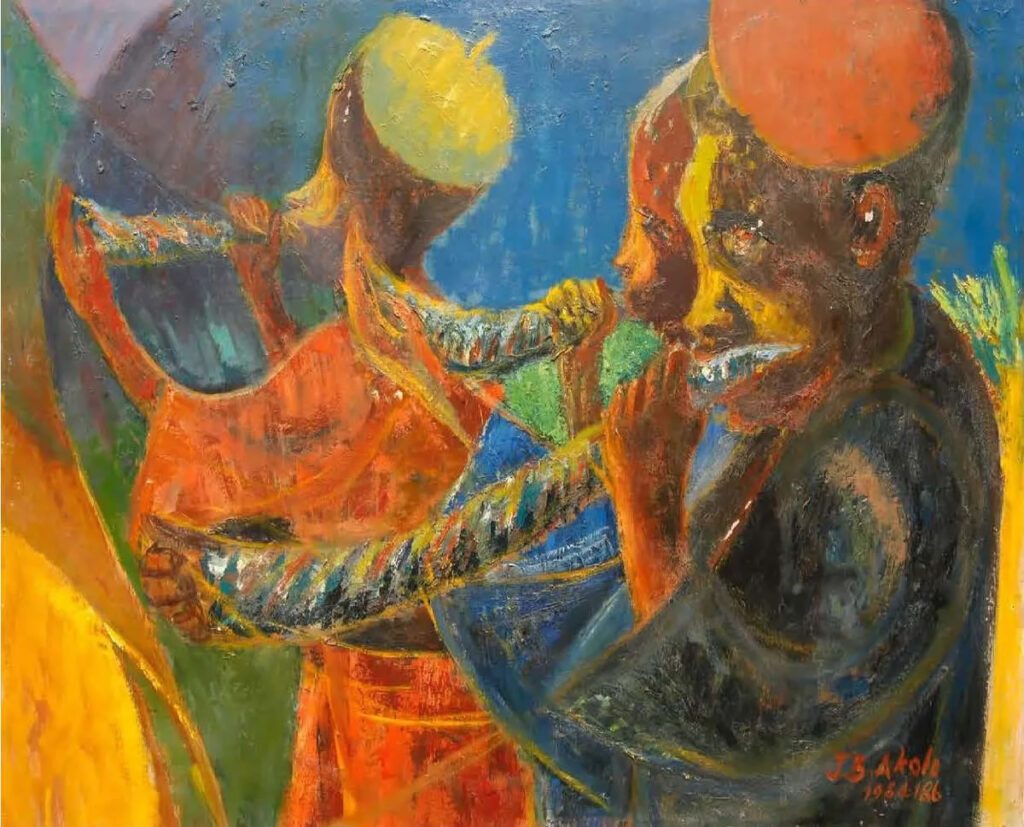
Jimo Bola Akolo’s artistic practice was deeply rooted in the philosophy of ‘natural synthesis,’ aiming to forge a contemporary Nigerian aesthetic that acknowledged both indigenous heritage and modern influences. His thematic concerns frequently revolved around cultural identity, spirituality, and societal structures. He drew extensively from the rich visual lexicon of his Yoruba heritage, incorporating traditional motifs, symbols, and narrative approaches into his compositions. This deliberate fusion allowed him to create art that was both deeply personal and universally resonant, reflecting the complexities of a post-colonial society navigating modernity.

Akolo’s style is characterized by its dynamic use of form, line, and color. His figures often possess a monumental quality, rendered with expressive distortion that imbues them with psychological depth. While engaging with figurative representation, he also explored abstraction, utilizing geometric and organic forms to convey emotional states or spiritual concepts. The artist’s palette often shifted from vibrant, earthy tones to more subdued hues, dictated by the emotional tenor of his subject matter, contributing to the evocative power of his work.

In terms of medium, Akolo was versatile, working across painting, drawing, and printmaking. His works on canvas, often executed in oil, are notable for their textural richness and layered narratives. He also demonstrated a strong command of drawing, where his skillful draftsmanship was evident in the nuanced depiction of human forms and the intricate details of his compositions. Through these diverse mediums, Akolo consistently interrogated the intersection of tradition and innovation, producing a body of work that remains central to the discourse on modern African art.

Cumulative sales

In the past six years, Jimo Bola Akolo’s market has seen $15,000 of cumulative sales at auction. This includes $0 of sales in the last two years to May 2026.

Lots offered vs lots sold

In the past six years, Jimo Bola Akolo’s works have been offered at auction one time, with a 100% sell-through rate.

Sales above/below estimate

In the past six years, 100% of Jimo Bola Akolo’s works sold at auction have exceeded the auction house low estimate.

Biography

Jimo Bola Akolo (1935–2023) emerged as a foundational figure in modern Nigerian art, contributing significantly to the cultural landscape of the post-independence era. Born in Egbe, Kogi State, Nigeria, Akolo’s artistic journey began at a pivotal time when Nigerian artists sought to define a visual language that honored indigenous traditions while engaging with global modernism. His early education laid the groundwork for a distinguished career that would span several decades and influence subsequent generations of artists.

Akolo’s formal artistic training took place at the Nigerian College of Arts, Science and Technology (now Ahmadu Bello University) in Zaria, where he was a prominent member of the influential Zaria Art Society, also known as ‘The Zaria Rebels’. This collective advocated for ‘natural synthesis,’ a philosophy that championed the integration of traditional African aesthetics, symbolism, and forms with Western art techniques and ideologies. This period was crucial in shaping Akolo’s commitment to creating art that was both globally resonant and distinctly Nigerian.

Following his studies, Akolo pursued further training abroad, including at the Slade School of Fine Art in London, an experience that broadened his technical proficiency and theoretical understanding. Upon his return to Nigeria, he dedicated himself to teaching and art-making, becoming a respected educator and practitioner. His work often explored themes of cultural identity, community, and the human condition, rendered through a distinctive style that became recognizable for its emotive power and intricate compositions.

Throughout his career, Akolo participated in numerous exhibitions both within Nigeria and internationally, solidifying his reputation as a key innovator in African modernism. His dedication to nurturing artistic talent and his prolific output ensured his lasting legacy as a pivotal figure in the development of modern Nigerian art.
Recent shows

Jimo Bola Akolo’s distinctive work was recently a highlight of the ‘Nigerian Modernism’ exhibition, reviewed by The Brooklyn Rail in December 2025. This significant presentation aimed to explore the origins and evolution of modern art in Nigeria, tracing key artists and movements that defined the nation’s artistic identity. Akolo’s contributions were singled out for their unique blend of indigenous African aesthetics with universal modernist principles, positioning him as a central figure in this formative period of Nigerian art history. The exhibition provided viewers with an opportunity to engage with the thematic depth and formal innovation characteristic of Akolo’s practice.